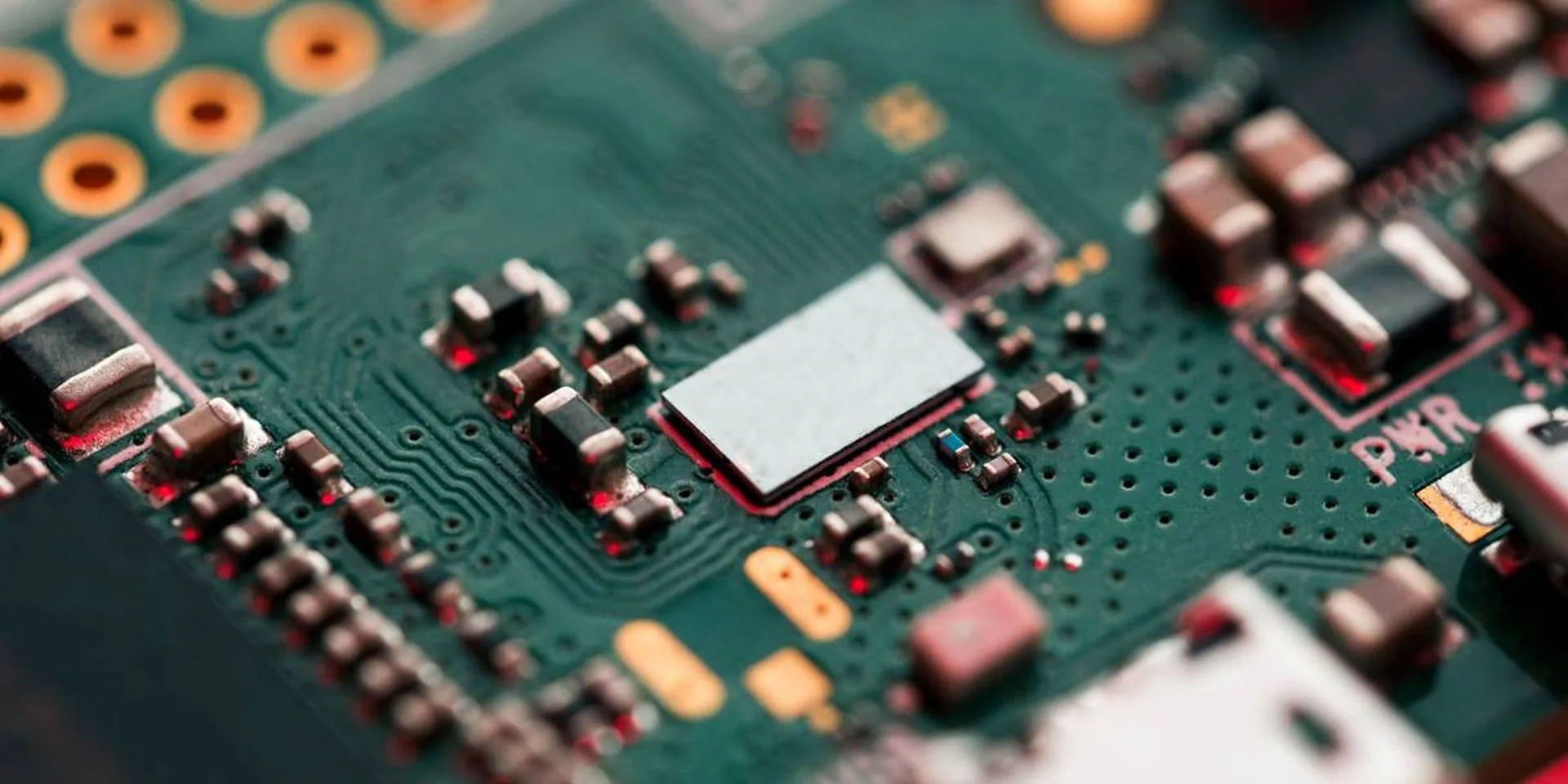
Hardware design
Electronics Design Services
Kyros Engineering provides electronics design services from first schematic to working hardware: circuit design, PCB layout, low-noise analog front ends, power electronics and the embedded firmware that runs on the board, carried through DFM review, prototype bring-up and EMC pre-compliance. One senior team designs the circuit, the layout and the firmware together, because the faults that cost a respin usually sit at the boundaries between them rather than inside any one of them.
Scope this with usElectronics design is usually bought in pieces. One contractor draws the schematic, another lays out the board, a third writes the firmware, and the first time all three meet is on a bench, under a deadline, with a prototype that powers up and does almost the right thing. The sensor reading wanders by a few counts. A regulator runs warm. The radio drops packets whenever the motor starts. Each vendor can show that its own piece met its own specification.
Those are not component failures. They are interface failures — between analog and digital, between the circuit and the copper, between the hardware and the code — and they are cheapest to prevent while one group of engineers still holds the whole design. We design electronics as one system, and we count a design as done when assembled boards run the product's real job on the bench, not when the files pass a design-rule check.
What we design
Boards and subsystems where the circuit decides whether the product works — the parts that measure, convert, control and communicate.
- Circuit design and schematic capture, with every part chosen against its real operating conditions — voltage, temperature, tolerance and lifecycle status — rather than the typical value on the first page of its datasheet
- Multilayer PCB layout for mixed-signal, high-speed and power boards, with the stackup chosen against real impedance and return-path requirements
- Analog front ends and low-noise sensing chains — instrumentation amplifiers, references, anti-alias filters, and delta-sigma or SAR converters
- Power conversion and distribution — DC-DC stages, battery charging and management, motor drive, and the protection around each
- Microcontroller subsystems on STM32 and other ARM Cortex-M parts, ESP32 and nRF, with the CAN, SPI, I2C, BLE and Wi-Fi interfaces the product depends on
- Test fixtures and bring-up tooling, so the tenth board is checked exactly the way the first one was
Analog front ends and low-noise sensing
Measurement electronics are where a clean-looking schematic most often turns into a disappointing board. We design the chain as one budget: the sensor's source impedance, the amplifier's noise density, the reference's drift, the converter's effective resolution at the actual sample rate, and the layout that keeps a switching supply out of all of it. Grounding, guarding and partitioning are decided at placement, not patched with copper tape after the first build. The noise and error budget is written down before layout and the finished board is measured against it, so the noise floor is a number with a derivation behind it — and when a reading is wrong, the budget says which stage to suspect first.
Power electronics, designed with the rest of the board
Most products contain a power design whether or not anyone calls it one: a charger, a handful of rails, an isolated supply, a motor driver. We design those stages with their control loops, thermal paths and protection, and we place them knowing which signals they can disturb. The hot loop of a switching converter, the return path of a motor current and the edge rate of a gate driver decide whether the analog section downstream reads clean, so power and signal are laid out together by the same engineers rather than one after the other. Startup, inrush and fault conditions are treated as requirements, not edge cases.
Hardware and firmware designed together
The split between what the circuit does and what the code does is an engineering decision with a cost on both sides: an analog filter or a digital one, a hardware comparator or a firmware limit, a dedicated timer peripheral or a software loop. Made late, those choices turn into respins and workarounds. We make them at the schematic, with the circuit designer and the firmware engineer on the same team and in the same review.
- Pin maps exported from the schematic, so the board and the firmware agree by construction rather than by inspection
- Clock, timer, DMA and interrupt choices made with the timing requirement in hand, not inherited from a development-kit example
- Bring-up firmware written alongside the layout, so the first board can be exercised rail by rail and interface by interface the day it arrives
- Fault handling designed from both sides — watchdogs, brown-out response and safe states that the hardware supports and the firmware actually uses
DFM, bring-up and a board that runs
Before release we review manufacturability against the fabricator and assembler who will actually build the board — footprints, trace and drill limits, testpoint access, part availability and assembly tolerances — and every connector, IC and custom footprint is checked pin by pin against its datasheet. The fabrication package goes out as one controlled release: gerbers, drill files, stackup, assembly drawings and a bill of materials that agree with one another. When boards come back, bring-up follows a written sequence: rails checked for shorts before power, a current-limited first power-on, every rail measured and recorded against the schematic, then clocks, the debug connection, first firmware, buses and each peripheral in turn. The board is done when it runs the product's real job through a power cycle.
Compliance-aware from the first schematic
Most of what decides a compliance result is fixed before layout begins. For medical electronics we design against IEC 60601-1 from the first architecture decision — isolation, leakage current, and creepage and clearance at the actual working voltage — and work inside the manufacturer's design controls, so verification evidence is generated with the design rather than reconstructed before a submission. For emissions and immunity, filtering, grounding, cable strategy and firmware recovery are design inputs, and pre-compliance checks run on the bench before a test house is booked, so the chamber day confirms a result instead of discovering one. We do not operate an accredited test lab or issue certifications; we get the design ready for the lab that does.
What you receive
Native design files in Altium, KiCad or Cadence, plus gerbers, drill files, netlist, stackup, assembly drawings, a bill of materials with manufacturer part numbers, firmware source, and the bring-up and test records for each build. You own all of the product-specific work on payment, so a second board house, or your own engineers two years from now, can pick the design up without having to call us first.
Where a project usually starts
New designs usually start with the architecture rather than the schematic: what the electronics must do, which parts carry real risk, and whether a development kit or module can carry the product through its next milestone. Kyros runs that as a two-week Architecture & Roadmap Study at $5,000 fixed, and you keep the written result whether or not we design the board. Existing designs start with a read of what is already there — schematic, layout, firmware and bench data — and a written account of what is worth keeping before anyone proposes starting over.
When to call
You probably want this if…
Frequently asked
What should I look for in an electronics design company?
Ask who will design the circuit, who will lay out the board and who will write the firmware — and whether those people bring up their own boards on a bench. Ask what files you will hold at the end, and ask to see how a design is released and brought up, not only how it is drawn. Kyros is an electronics design company in Cleveland, Ohio, working with clients nationwide: one senior team designs the circuit, the layout and the firmware, and a principal engineer leads every project.
Do you offer electronic circuit design services without the layout or firmware?
Yes. Electronic circuit design services on their own — part selection, schematic capture, simulation where it earns its place, and a written design review — are a common bounded engagement. If another team will lay out the board, we hand over the layout constraints the circuit depends on: the hot loops, the sensitive nodes, the return paths and the parts that must sit together. A correct schematic can still be laid out into a noisy board, and those constraints are what prevent it.
When does a product need custom electronics design instead of off-the-shelf modules?
When the off-the-shelf version can no longer meet a requirement that matters — unit cost at volume, size, power consumption, a measurement a module cannot make cleanly, or a certification it cannot pass. Until then, development kits and modules are usually the faster and cheaper way to prove the product works. Custom electronics design pays for itself once the risky part is proven and the requirements have stopped moving; a custom board designed before that point tends to be a well-made board for the wrong requirements.
Can you design electronics for a medical device?
Yes. We design medical electronics against IEC 60601-1 for electrical safety and IEC 60601-1-2 for EMC, and we work inside the manufacturer's design controls so that requirements, verification and traceability are produced alongside the design. Kyros is not ISO 13485 certified and does not claim to be: the certification belongs to the manufacturer's quality system, and we supply the engineering and the evidence that system needs.
Do you build the boards, or only design them?
We design them, and we can run the build or hand it off. Fabrication and assembly go through board houses we have vetted and coordinate on your behalf, or we deliver a controlled package complete enough that any competent house can build from it without calling us. Kyros is not a contract manufacturer. In both cases we normally bring up the first boards ourselves, because bring-up is where a design is actually proven.
Have a product that needs its own electronics?
Send us the block diagram, the schematic, or just the requirement. We will tell you where the design risk actually sits before you commit to a scope.